Brain Tumor Surgery
What is a Brain Tumor?
A brain tumor is a mass that occurs as a result of the abnormal growth of cells in the brain or the tissues surrounding the brain. It can be benign or malignant. Some tumors originate from the brain itself (primary), while others may spread to the brain from another part of the body (metastatic). Early diagnosis and proper treatment planning are of great importance for the patient's quality of life and survival.
What are the Symptoms of a Brain Tumor?
Symptoms may vary depending on the location of the tumor and its size.
The most common symptoms include:
• Persistent and progressively worsening headache
• Nausea and vomiting
• Visual disturbances (double vision, blurred vision)
• Difficulty speaking
• Weakness in an arm or leg
• Balance problems
• Seizures (epileptic attack)
For new-onset and unexplained neurological complaints, specialist evaluation is necessary without delay.
What are the Types of Brain Tumors?
The most common brain tumors are meningiomas, gliomas, pituitary adenomas, and metastatic brain tumors. Brain tumors require different treatment approaches depending on the cell type, location, size, and clinical findings.
How is a Brain Tumor Diagnosed?
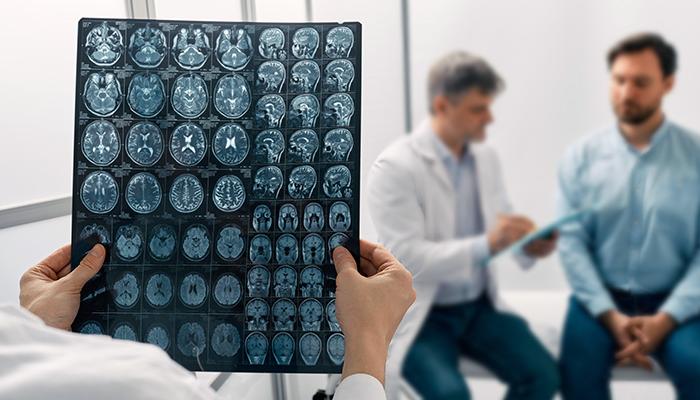
The diagnostic process for a brain tumor requires a multidisciplinary approach. First, the patient's complaints are evaluated in detail, and a comprehensive neurological examination is performed. Subsequently, imaging methods such as Magnetic Resonance Imaging (MRI) and, when necessary, Computed Tomography (CT) and angiography are utilized. Advanced imaging techniques (such as functional MRI) may be used to assess the tumor's location, size, and characteristics in more detail. In cases where a definitive diagnosis is necessary, it is possible to obtain a small piece of the tumor using a closed method through a navigation-guided stereotactic biopsy, allowing for pathological examination and a definitive diagnosis. An accurate diagnosis forms the basis for creating the most appropriate treatment plan.
What are the Treatment Methods for Brain Tumors?
The treatment plan for a brain tumor is determined based on the type, size, location of the tumor, as well as the patient's clinical findings and general health status.
The most frequently employed treatment method is surgery. The goal of surgical treatment is to remove the tumor as extensively as possible within safe margins. Today, by combining microscopic, endoscopic, and minimally invasive surgical techniques with advanced imaging, neuronavigation, and neuromonitoring systems, surgeries are performed most safely, minimizing the postoperative hospital stay, thereby increasing patient comfort and shortening the recovery time.
In addition to surgery, or alone in some cases, the treatment process can be supported with laser therapy (LITT), stereotactic (SRS) or conventional radiotherapy applications.
Chemotherapy and patient-specific targeted (smart) drug therapies can potentially treat the tumor or prevent its recurrence.
The treatment process is planned specifically for the patient by a multidisciplinary team – thus, by applying surgery, laser therapy, radiotherapy, and chemotherapy together, the aim is to achieve the best result in the shortest time and most safely.
Advanced Technology in the Surgical Treatment of Brain Tumors
Yeditepe University Hospitals bring together advanced imaging systems, high-tech hybrid operating rooms, and a multidisciplinary academic approach in the diagnosis and treatment of brain tumors. Surgical planning is personalized for each patient. Preoperatively, high-resolution 3 Tesla MRI systems, mapping of speech and motor centers using functional MRI (fMRI), determination of nerve pathways using diffusion tensor imaging (DTI) ensure the tumor's location is determined with millimeter precision. When necessary, 3D angiography can visualize the vascular structures within the tumor in the finest detail.
During surgery, neuronavigation systems and minimally invasive techniques are used to reach the tumor via the shortest and safest route without damaging normal tissues, and continuous neuromonitoring aims to preserve nervous system functions.
Furthermore, intra-operative MRI imaging performed during surgery ensures that the entire tumor has been removed, minimizing both the risk of a second surgery and recurrence.
Our Branches With This Unit